Employees as training data: Microsoft, Meta, xAI
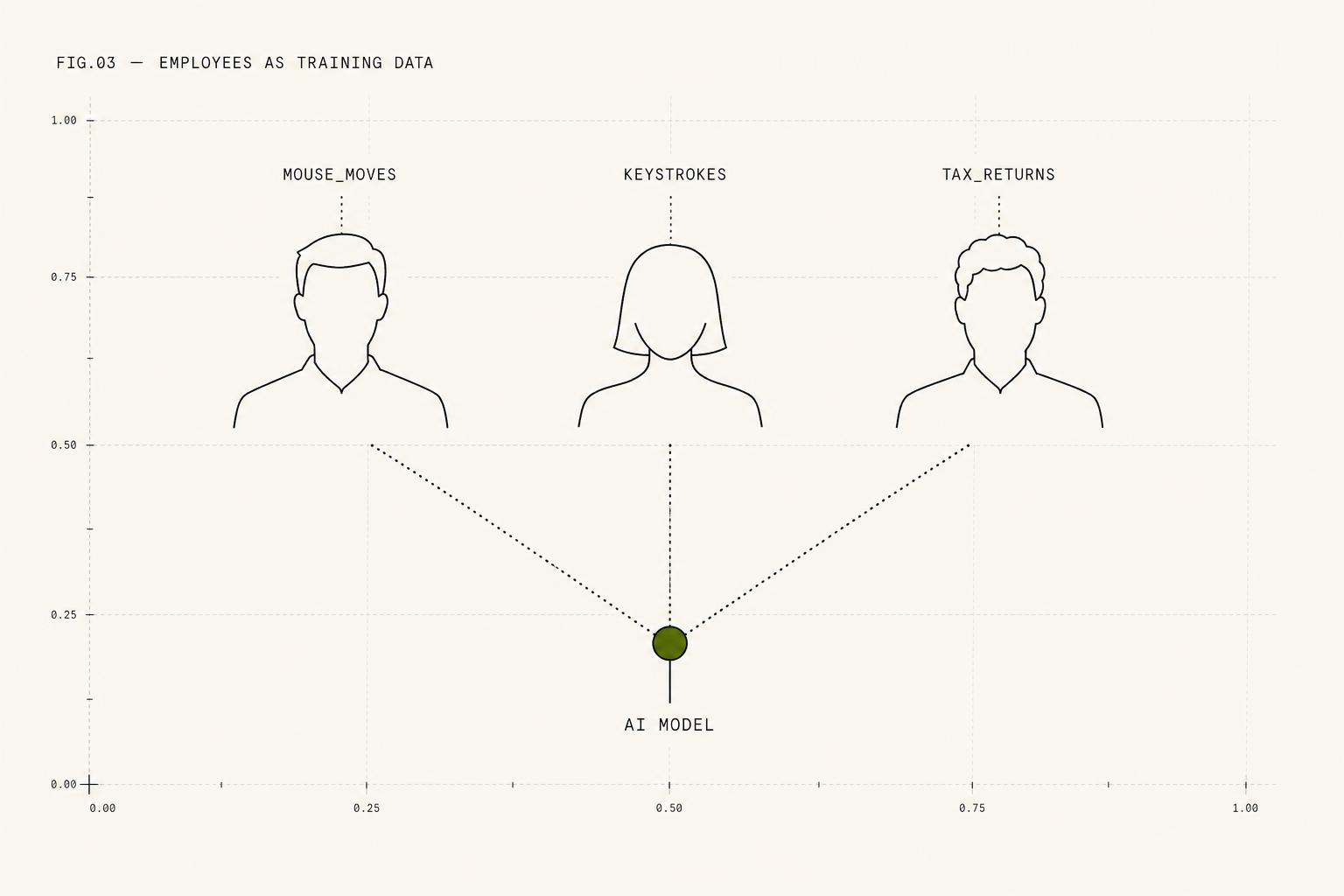
Microsoft has 100,000 engineers. Meta tracks mouse and keyboard. xAI offers $420 for your tax return. The next batch of AI training data comes from in-house staff — and it has consequences for how you set up your own AI stack.
Microsoft has 100,000 engineers. Meta tracks mouse and keyboard. xAI offers $420 for your tax return. The next batch of AI training data comes from in-house staff — and it has consequences for how you set up your own AI stack.
Microsoft has a weapon Anthropic and Cursor don't: roughly 100,000 in-house developers. Meta is tracking employee mouse movements. xAI is offering $420 for your tax return. The AI race has entered a new phase — and your colleagues are the training data.
Who pays for the next generation of models?
The short answer: employees do. Not in cash, but in data. The big AI labs have already combed through the public internet, harvested most of YouTube, GitHub and Reddit, and are hitting the wall of copyright disputes and source exhaustion. The next layer — high quality, unseen by other models — comes from one place: the people working for the company every day.
What stands out is how differently the three biggest players are doing this, and how unapologetic it has become.
Microsoft: 100,000 engineers as an RLHF pool
Microsoft is trailing Anthropic and Cursor in coding AI. Internally, more and more Microsoft engineers are reaching for Claude Code instead of GitHub Copilot. But Microsoft has one thing its competitors don't: an army of roughly 100,000 software engineers on payroll.
Recent reporting indicates Microsoft is collecting data from internal VSCode installations, from the source code of Xbox-owned game studios, and — more interestingly — from how its own engineers behave inside GitHub Copilot. Which suggestions do they accept? Which do they ignore? Which do they rewrite before committing?
That last bit isn't raw training data, it's something far more valuable: preference data. The kind of signal modern reinforcement learning pipelines run on. That's why Microsoft is actively pushing its own people back toward Copilot rather than Claude Code — not just for narrative reasons, but because every accepted line is a data point OpenAI and Anthropic don't have.
Dogfooding itself isn't new. Google and OpenAI do it too. What's new is that dogfooding has now become the primary data strategy rather than a QA step.
Meta: mouse, keyboard, dropdown — all of it
Meta goes a few steps further. The company is rolling out a tool called Model Capability Initiative (MCI) that captures mouse movements, clicks and keystrokes on U.S. employee work computers. The goal: training data for agents that learn "computer use" — think of an agent navigating a dropdown, clicking a button, filling out a form.
Mark Zuckerberg told staff this would be "especially valuable" because Meta employees are "very smart." Whether that compliment made the surveillance feel better is unclear. What Platformer does report: employees are pushing back by consistently ignoring the "accept" button in the permissions popup, and some have found ways to disable the software via system settings entirely.
On top of that, the software is apparently also just buggy. "MCI makes everything super slow," one employee wrote; keyboard and mouse input becoming laggy. A Meta spokesperson framed it as a necessity: agents that help people complete everyday tasks need real examples of how people actually do those tasks.
xAI: $420 for your tax return (not paid yet)
The most awkward variant comes from xAI. According to Bloomberg, the company offered employees $420 apiece to "donate" their U.S. tax returns — as well as those of friends and family members — as training material for Grok's financial capabilities.
Two months later: the money hasn't been paid to the staff who contributed. The $420 price tag is a meme wink that only works if the cash actually arrives. For anyone reading this from a privacy angle: tax returns contain income, dependents, gifts, charitable donations, medical expenses, mortgage structures. It's hard to think of a more sensitive dataset.
Why employees, not customers?
The simple answer: employees can't really say no.
Asking customers for training data takes work. It takes an opt-in flow, a legal review, a trust conversation about what's in and what's out. And most customers say no — especially enterprise customers who specifically have a no-training clause in their contract. (Something Lovable Cloud, Azure OpenAI and the Anthropic Enterprise tier each have their own version of.)
Employees, by contrast, sign an employment agreement. The power is asymmetric. A popup with "accept" feels to an employee like a soft mandate rather than a real choice. And the scale is huge: 100,000 Microsoft engineers generate more high-quality coding data in a week than a public GitHub scrape does in a month.
The quiet shift: raw data → preference data
The most interesting development isn't the scale, it's the type of data. The large models have been trained on raw internet text to the point of diminishing returns. The win now lies in signal: which suggestion was accepted, which was rewritten, which was rejected.
For coding AI that's gold. An engineer who edits a Copilot suggestion before committing provides far richer signal than a random GitHub file. The diff between the generated version and the committed version is the feedback — free RLHF, no human labelers required.
The same holds for Meta's computer-use agents: clicking buttons in synthetic data looks different from a real user who hesitates, scrolls back, half-opens a dropdown and closes it again. That noise is the data.
What this means for your own company
Three things, in order of importance:
- Re-read your AI vendor contract. Many SaaS tools hide no-training defaults in the Enterprise tier and default to "do train" on Pro/Team plans. Specifically for coding agents: check whether Cursor, Copilot and Claude Code in your setup send your code back to the provider for training. For most of our clients we answer this question during onboarding — the difference between "data stays on-prem" and "data is anonymously aggregated for model improvement" is not small.
- Make policy explicit, not implicit. If you're building your own internal tools — a chatbot, an agent, a document extractor — decide upfront whether you'll use logs for fine-tuning. Write it down. Communicate it to your team. An implicit "of course we don't use it" doesn't hold up the moment the product manager behind the tool becomes more ambitious.
- On-prem for what's actually sensitive. For clients where data must not leave the company — insurers, real estate, legal — we increasingly build with OpenClaw as the on-prem orchestration layer. Local Llama or Qwen models, own Postgres, own audit log. Not because we're paranoid, but because the existing "trust us" story carries slightly less weight when Meta no longer trusts its own people.
Finally
The AI industry got to ride free internet data for a few years. That river has dried up. What's left is expensive, slow, or morally grey. Employees are the cheapest, fastest, greyest of the three.
For anyone building agents themselves the lesson isn't "stop dogfooding" — it's the best way to learn quickly what works. The lesson is: be explicit about what you collect, what you use it for, and give people a real off switch. Otherwise you end up building, sooner or later, an MCI popup no one clicks.